زبانداد
نسخهی انگلیسی زبانداد
First published in
***
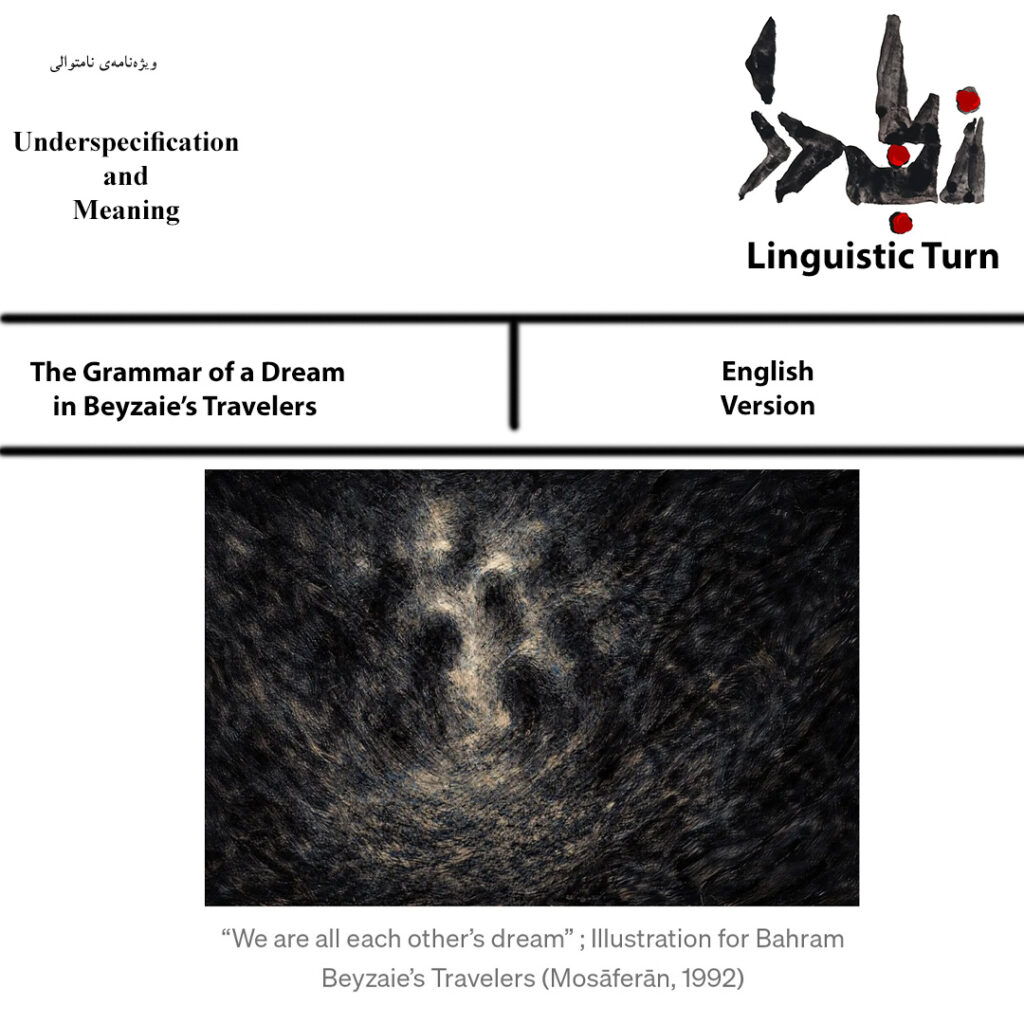
A single line in Travelers (Mosāferān, 1992), directed by Bahram Beyzaie (26 December 1938–26 December 2025), poses a question of translation grounded in the subtle ambiguity of a single grammatical number. Khānom Bozorg (the Grand Dame, or Grand Lady of the household) says: «ما همه رویای همایم» (Mā hameh royā-ye ham-īm). In English, should this be rendered as “We are all each other’s dream,” or as “We are all each other’s dreams”?
The difference is slight, but not neutral: it shapes how dreaming is understood — as individual possessions or a shared condition — and how relations are imagined. One — “We are all each other’s dreams” – is fully grammatical and idiomatic. It conforms to standard expectations of number agreement between a plural subject and a plural predicate nominal in a reciprocal construction. By pluralizing the predicate, it steers interpretation toward a reading in which dreams, and dream-relations, are parceled out and treated as multiple. This is a grammatical specification that the Persian formulation itself does not impose.
The other –“We are all each other’s dream” – pairs a plural subject with a singular predicate nominal as a subject complement. This version is less frequent and stylistically marked, yet it is not strictly ungrammatical in English. Because it does not mark plurality at the level of the predicate, it more closely preserves the Persian line’s lack of explicit distributive marking. So the issue is not correctness versus error, but a tension between adhering to grammatical conventionality in the target language and fidelity to the construal encoded in the source text.¹
In ordinary English usage, the plural is the default choice. Constructions such as “we are each other’s friends” are fully grammatical: a plural subject combines with a plural predicate nominal under straightforward agreement, yielding a set of parallel, countable relations and instantiating a distributive construal. In reciprocal constructions of this kind, the plural predicate nominal is expected. A singular predicate nominal with a plural subject (“we are each other’s dream”), therefore, sounds marked to many speakers. This markedness reflects usage frequency and stylistic expectation rather than grammatical impossibility.
Some grammatical accounts note that reciprocals, including “each other” license singular predication, on the grounds that the relation is evaluated participant by participant even when plural reference is intended.² Apart from such accounts, English also permits singular predicate nominals when the predicate is understood as a shared condition or abstract relation. In such cases, the grammar does not determine how the relation is distributed among participants; the singular allows the actual mechanics of that distribution to remain implicit, rather than being partitioned into a set of separate, individual instances.
With this grammatical background in place, the immediate dialogic context clarifies what is at stake. The line follows an earlier remark addressed to Mahrokh: «فعلاً که تنها رویاش تویی» (“For now, you are his (the groom’s) only dream”). Here, royā (رویا) is clearly singular and possessive. One person is presented as the exclusive focus of another’s desire or hope. Mahrokh then responds: «چطوری میشه آدم رویای یکی دیگه باشه؟» ( “How can someone be another person’s dream?”) The exchange establishes a framework in which dreaming is assigned and individually owned.
At this point, Khānom Bozorg could have responded within that same framework. She might have affirmed an individuated view of dreaming through an utterance such as «هر کسی رویای کسی است» (“Everyone is someone’s dream”) or «هر کس رویای یکی دیگه است» (“Everyone is someone else’s dream”) – forms that keep dreaming divisible and reallocable across persons. Such a reply would preserve the premise of distributive ownership of dreams while extending it. Instead, Beyzaie gives her a line that breaks with that logic. «ما همه رویای همایم» does not redistribute private dreams or restate them at a higher level of abstraction. It suspends the assumption that dreaming must be encoded as something owned or (grammatically) assigned among individuals.
This distinction becomes significant in translation. Persian allows the singular royā (رویا) to function without forcing an immediate choice between a countable noun and an abstract condition — between a particular dream and a state of dreaming that may be understood as imagining, projection, or a shared orientation. English, by contrast, requires a grammatical decision that tends to make such distinctions explicit. The plural “dreams” introduces overt plural marking at the predicate and in this co-text directs interpretation toward a distributive construal by presenting dream-relations as multiple and separately attributable.
The singular dream withholds that specification. Crucially, this does not mean that the singular cannot support a conventional distributive reading in English; such uses are not without precedent. At the same time, the singular remains compatible with a non-distributive construal that conceptualizes dreaming as a shared process. In this capacity, the singular predicate creates a conceptual blend in which the participants are unified: rather than a set of parallel relations, the grammar evokes a singular space where the plural (in this case, “we”) is no longer a collection of individuals, but an indivisible entity. This dual availability allows it to function more like the Persian, which permits both readings without forcing either one to the surface.
“We are all each other’s dream,” much like «ما همه رویای همایم», hints at a relation in which participants are mutually constitutive. In this rendering, each person is not merely a participant in a relationship but indispensable to a shared structure of meaning. This grammatical choice commits the line to an ethical stance: if we are “each other’s dream”, then to “let go” or “move on” is not an act of “realism” or “maturity”, but a fundamental withdrawal from the shared structure of our own existence.
This is why Khānom Bozorg does not merely resist the travelers’ death; she actively confronts those who accept it, viewing their “realism” as a form of cruelty. To her, mourning becomes a betrayal – a conceptual “pluralizing” of the dream that treats the dead as a divisible part that can be removed. Her refusal to mourn is an active maintenance of relational bonds in which dreaming is not an illusion opposed to reality, but the very mode through which reality is sustained.
I am not suggesting that either the Persian utterance or the English rendering functions as an ontological or sociological argument. Their force lies instead in what their grammatical form allows to be inferred without being explicitly stated. They affirm mutual involvement in a shared process of dreaming while declining to encode that involvement in a determinate grammatical form. What we have here is a hint–a hint at a possibility: a dream that refuses to normalize the loss of (even) a single dreamer, or to succumb to a logic that dismisses catastrophe as a mere “fact of life.”
Footnotes
1. This discussion sets aside the alternative reciprocal form “one another”, which some prescriptive accounts prefer when more than two participants are involved. Contemporary English usage overwhelmingly favors “each other” in both dyadic and plural contexts, and nothing in the Persian construction motivates activating that distinction here.
2. Some grammatical analyses allow singular predication in reciprocal constructions on the grounds that “each” evaluates the relation participant by participant. This discussion does not rely on that logic; it is noted only to clarify that the singular form cannot be dismissed as strictly ungrammatical.
3. This reading does not presume that the singular royā (رویا) denotes a collective or ontological unity. It attends to what Persian grammar allows to remain unspecified and what English grammar tends to resolve. The suggested preference for the singular “dream” is a translational strategy that has a real chance at preserving the original line’s refusal to “atomize” the characters into separate units, giving them the possibility to stay within a shared configuration.